
Updated Aug. 2026
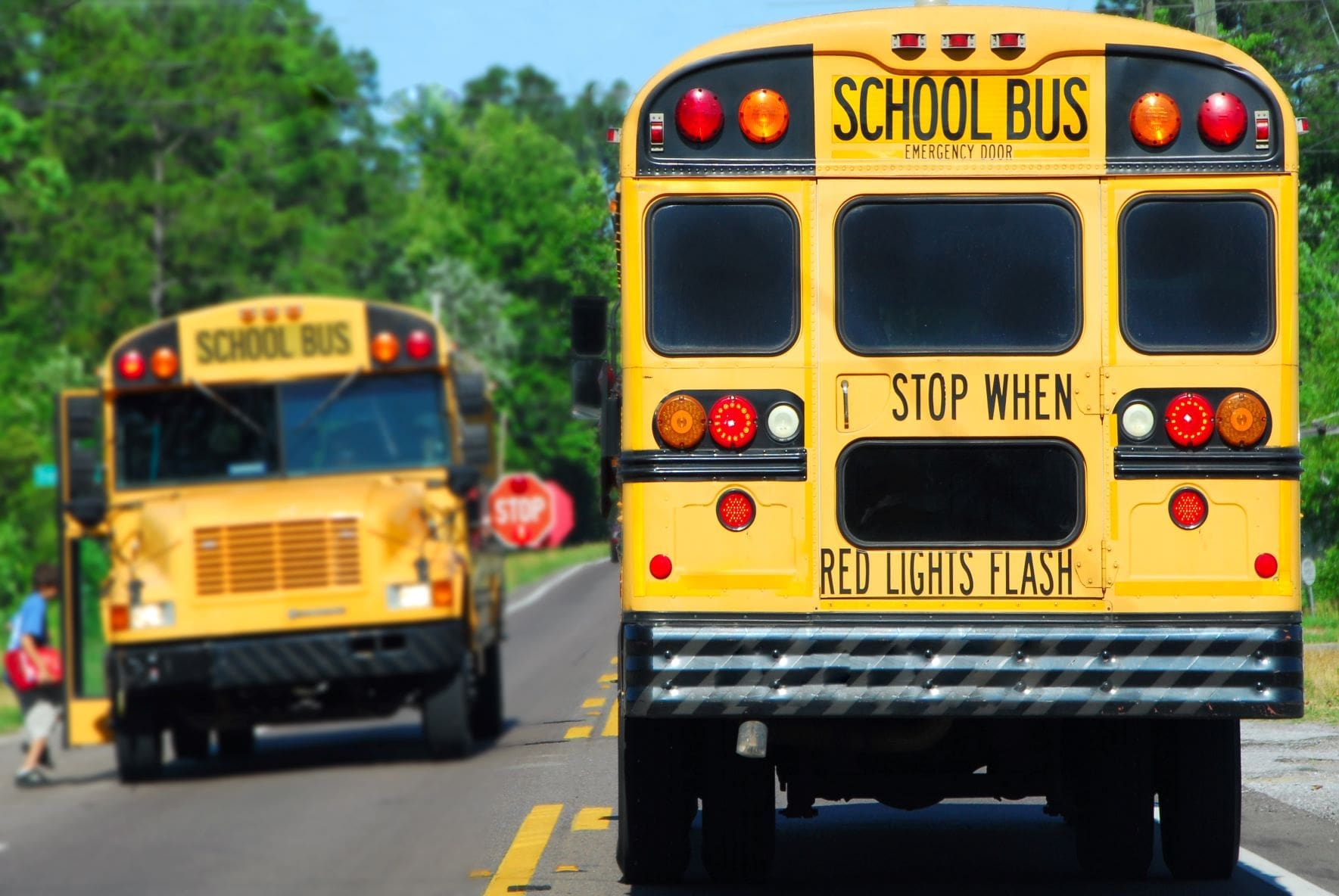
August means back-to-school time for our kiddos. This is a good time to remind everyone what to do when you see a school bus in North Carolina. The North Carolina traffic laws around school buses are designed to keep children entering and exiting buses safe. However, the law depends on the type of road you are traveling on.
School buses often have to stop on very busy roads, and these laws ensure every child gets on and off the buses safely.
What Is the North Carolina School Bus Stop Law?
North Carolina has had laws that prohibit passing a stopped school bus in NC on the books since the late 1980s. Since that time, there have been additional statutes passed that increased the penalties, license revocation, and, most recently, allowed the use of school bus safety cameras to catch violators. (More to follow on the penalties for passing a school bus.)
The most important thing to understand about the NC school bus law is that it reflects just how serious student transportation safety is. This law was designed to protect our children when they are going to and coming from school.
When Must Drivers Stop for a School Bus?
North Carolina traffic laws require that as soon as you see a school bus with flashing yellow lights, you are required to start slowing down so that by the time the school bus’s stop arm has been extended, you are at a complete stop. The amber lights are to alert you to slow down.
Additionally, there are five different roadway scenarios for school bus laws in North Carolina. Depending on the type of road you are traveling on, the rule for stopping is different. It is imperative that you know when you are supposed to stop based on the roadway.
-
Two-lane roadway: You must slow down as soon as you see the yellow flashing lights when you are traveling in both directions and come to a full stop when the school bus stop arm is extended.
-
Two-lane roadway with a center turning lane: You must slow down as soon as you see the yellow flashing lights and come to a full stop when the school bus stop arm is extended when you are traveling in both directions.
-
Four-lane roadway without a median separation: You must slow down as soon as you see the yellow flashing lights and come to a full stop when the school bus stop arm is extended when you are traveling in both directions.
-
Divided highway of four lanes or more with a median separation: If there is a median separation, you must slow down as soon as you see the yellow flashing lights and come to a full stop when the school bus stop arm is extended if you are traveling in the same direction as the school bus. If you are traveling in the opposite direction, you are not required to slow down or stop.
-
Roadway of four lanes or more with a center turning lane: You must slow down as soon as you see the yellow flashing lights and come to a full stop when the school bus stop arm is extended if you are traveling in the same direction as the school bus. If you are traveling in the opposite direction, you are not required to stop.
Click here for a visual representation of when to stop for a school bus.
Check out this video from the North Carolina Department of Transportation about school bus stop safety.
Common Misunderstandings and Mistakes
Most confusion around the bus stop law is due to the yellow (amber) flashing lights on a school bus. These common misunderstandings for drivers are most likely to put children at risk:
-
Thinking Yellow Means “Keep Going.”
Many drivers think the yellow flashing lights mean “keep going” or “hurry up and get through,” like it is a yellow traffic light. However, the yellow flashing lights mean “SLOW DOWN!” When the yellow lights start flashing, the bus is preparing to stop, and children will be loading or unloading.
-
Not Anticipating the Stop Arm/Red Lights.
The yellow flashing lights are a warning that the red stop arm will be extended soon. Begin to slow down as soon as you see the flashing yellow lights since the bus may stop quickly.
-
Stopping Too Late.
Drivers wait until the red stop arm is fully extended before reacting. This can lead to a very dangerous situation since the bus has already started to load or unload children.
-
Assuming It’s Optional.
Drivers do not know that it is the law in North Carolina to slow down and come to a complete stop. It is not a suggestion, and the penalties for violations are severe to keep children safe.
-
Distracted Driving.
Just another reason to put your cell phone down and make sure you are fully present in watching the road.
Penalties for Violating the Bus Stop Law in NC
Passing a stopped school bus in NC is a very serious driving violation. Worse than the expense is the possibility of hurting a child. This is what you can expect if you pass a stopped school bus:
-
There is a minimum fine of $500.
-
A Prayer for Judgement Continued (PJC) is not allowed. Offenders can not plead to reduce or avoid a formal conviction.
-
You will have 4 safe driver insurance points. The points will increase your insurance premium by 90% and will be applied for 3 years.
-
If a person is struck or killed, it is a felony with a license revocation, an increased fine, and jail time.
-
In districts utilizing automated camera enforcement like Lee County, vehicle owners caught on camera face penalties of $225 for for a first offense of ignoring a stop arm. The school bus stop arm camera program is being implemented in school districts across the state to protect students.
5 Driver Safety Tips for North Carolina Drivers
-
Distracted driving is the number one cause of accidents in North Carolina. Make sure your phone is not in your hand, your podcast is already playing, and your GPS has the directions up BEFORE you pull away.
-
Know when to stop for school buses to avoid future confusion. Print the diagram for reference so you are fully aware of the roadways and stopping requirements.
-
Increase your following distance so you have plenty of opportunity to slow down and stop if a bus suddenly puts its flashing yellow lights on.
-
Expect the unexpected around school bus stops and school buses. Children often dart into the road or suddenly stop and go the other direction without warning.
-
Be Patient. The few extra seconds you take are worth the safety of a child.
For more tips and additional information on NC school bus law, click here.
What Parents and Students Should Teach Their Kids About Bus Safety
-
Teach the “10-Foot Rule”
Remind children to stand at least 10 feet away (about 5 giant steps) from the curb or roadway while waiting for the bus. This gives the driver a clear view of them and keeps them away from traffic. -
Wait Safely at the Stop
Get to the bus stop a few minutes early. Running after the bus is very dangerous. Children should wait in a safe spot, away from the street, not playing or roughhousing near the curb. -
Board Carefully
Wait until the bus has completely stopped and the door opens before approaching. Always use the handrail when getting on and off. -
Crossing the Street
If a child must cross the road: Wait for the driver to signal it’s safe. Look left, right, then left again. Cross 10 feet in front of the bus so the driver can see them. Never cross behind the bus. -
Be Visible
Bright clothing or reflective gear helps drivers see children, especially in the early morning or on dark afternoons. Avoid hoodies pulled up or headphones that block sound awareness near traffic. -
Teach “See the Driver, Be Seen”
Children should make eye contact with the driver before crossing. If they can’t see the driver, the driver likely can’t see them. -
After Exiting the Bus
Move away from the bus right away. Never pick up dropped items (like papers, phones, or toys) without telling the driver first. Kids can disappear from view quickly. -
Set a Good Example
Parents should practice safe habits when walking near the bus stop. Use crosswalks, avoid distractions, and show kids how to be alert.
Safety for Our Community is Top Priority
At O’Connor Insurance Associates, safety is always our top priority. We care deeply about protecting children, families, and drivers in the communities we serve across North Carolina.
Understanding North Carolina’s school bus laws, especially when to stop for a school bus, is an important step in keeping everyone safe. This time of year brings new school bus drivers, unfamiliar routes, and children who may be riding the bus for the first time, making driver awareness more critical than ever. We encourage all motorists to stay alert, slow down, and do their part to keep our roads safe.
If you’re looking for an insurance partner who values safety as much as you do, contact O’Connor Insurance Associates today to review your coverage and protect what matters most.
Share With A Friend!
Join us in spreading the word about school bus safety this season. Take a moment to review North Carolina’s school bus laws today, and share them with your family and friends.
Knowing when to stop can save a life.
If you would like more safety tips, follow along on Facebook or join our newsletter for real-time updates and tips!
Let’s all do our part for student safety! Slow down, pay attention, and always stop when required. Together, we can keep our children and roads safe.
North Carolina School Bus Stop Law FAQs
When do I have to stop for a school bus in North Carolina?
You are required to slow down when the yellow lights start flashing on a school bus. You must be at a complete stop when the red stop sign is extended. This applies to all roadway scenarios in North Carolina.
What is the penalty for illegally passing a stopped school bus in NC?
There is a minimum fine of $500 for illegally passing a stopped school bus in North Carolina. A Prayer for Judgment Continued (PJC) is not allowed, as offenders can not plead to reduce or avoid a formal conviction. If a person is struck or killed, it is a felony with a license revocation, an increased fine, and jail time. The offender will have 4 safe driver insurance points added to their record, increasing their insurance premium by 90%, applied for 3 years.
Do I have to stop for a school bus on a four-lane road in North Carolina?
Yes, unless there is a physical median or a center turning lane, you have to stop for a school bus on a four-lane road in North Carolina.
How can I tell if a road is divided and I don’t have to stop?
If there are four or more lanes and a physical median separation exists, or a center lane separation, you do not need to stop.
Are school bus cameras used to enforce the stop law in NC
Yes, North Carolina state legislative updates (such as SB 411) establish that recorded camera footage acts as prima facie evidence of a failure to stop, making civil penalties ($400+ fines) swift and enforceable.
What should I teach my child about school bus safety?
It is important to keep your child the importance of school bus safety, including standing off the road on the designated sidewalk, waiting until the bus has come to a full stop and the door has opened before moving toward the bus, wearing bright clothing especially in the fall and winter, and looking both ways after you exit the bus and before you cross a road.